
I noted with sadness the passing of John Prados, 71, a noted author, historian and game designer. And while probably unknown to most of you, I recognized him right away. Among the dozens of games he designed was “Rise and Decline of the Third Reich.” A heinously complex WWII strategic level simulation of the war in Europe produced by Avalon Hill of fond memory in the mid-70s and been in print in one form or another ever since.
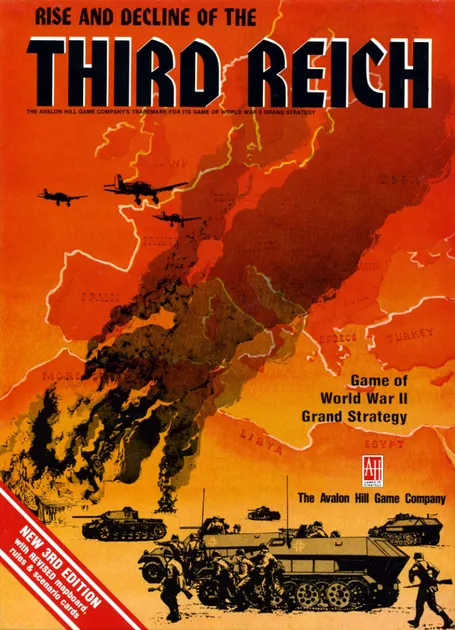
We’re not talking about video games here, but real tabletop, dice-rolling, move-the-cardboard-counters-on-a-hex-map wargames. Avalon Hill and SPI defined the genre and my friends and I spent who know how many hours playing these games. Again, this was before home computers, the Internet, hell, even cable TV. Titles like Panzer Blitz/Panzer Leader, Squad Leader/ASL, Operation Cobra, etc. But the granddaddy of them all was “Third Reich.”
Probably the most popular among the more casual gamers was Panzer Blitz. A company level simulation of the Eastern Front of WWII, you could play a scenario in 1-2 hours, making it great for casual play and pick up groups at local meetups. AH rated their games for complexity on a scale of 1-10 and this was a 6. More detailed/interesting than something like Risk or Axis Allies, but with a thin rule book and quick to grasp mechanic.
Those more historically inclined of us gravitated to more complex and detail-oriented games. You could go one of two ways here: smaller scale with more detail, or larger scale with more scope than simple combat. Most of the time we went with smaller scale, the time to play a typical scenario in Squad Leader (later, Advanced Squad Leader) was around 2-3 hours. This was a company-level WWII wargame with millions of cardboard counters (you only used 50-100 at a time) and configurable map boards to simulate almost any battlefield terrain.
But, when we were feeling particularly froggy (and had a LONG window of time), we’d go the other way, wide-scale and pull out Third Reich, complexity rating: 10/10. Time to play 12-24 hrs. For hard-bitten cardboard warriors this added new dimensions: diplomacy and resource management. Also, unlike most of the other games we played it was made for up to 6 players. In fact, it was only interesting with more than four.
Probably more than any other game we played, this simulation resembled reality the best. Not in the details, but in how you had to juggle the competing demands of strategy, diplomacy and production. The time scale was 3 month turns, so you might have a good quarter there Germany (Spring 1940), but the long game is not your friend.
Anyway enough prattling on about my misspent youth. John Prados was a historian focused on WWII (obviously) and the Vietnam war. As an author, he was one of the pioneers of using the then new FOIA to prize inconvenient information out of the government. Information which formed the basis of several books on Cold War strategy, the actions of the CIA and the Vietnam War. Most of these are still available one way or another and are quite readable and relevant.
As to his other games, they are mostly WWII or Napoleonic era simulations and, learning from the Third Reich, less complex and shorter to play. So they probably sold a whole lot better. Although Third Reich did quite well for the type of game it was. Though, I suspect more people owned it than ever played even one of the six scenarios all the way through. I’m tempted to check out a few of them, but…shesh I already have way more to do with my free time than I can handle.
So thanks John, you helped quite a few people become interested in Military History, Strategy and International Relations. And, torqued off not a few government types with the exposes on Vietnam and the CIA along the way.