
General Thoughts:

A very exciting day is in store, as I get to figure out how to take a ferry with a car! In a foreign country! Where I can’t even read the language!
While we were waiting for the charge to top up, we walked down to the beach at Vík. After all, there was nothing else open at 0830, because…rural Vík. It was a dim and drizzly morning. Unlike Diamond Beach, the beach here is fairly narrow, so it’s helpful to keep an eye on the wave action to avoid being surprised. We took some photos and had no issues. Then headed back to “town”.
We still had some time to kill, both for the car to charge and to catch the ferry to the Westman Islands. However, it was after 0900 and the Icewear Store was open, so we went shopping. This is one of the local (to Iceland) fancy outfitter-type stores (think REI for cold weather). It was filled with the usual tourist stuff, but also excellent, high-quality, locally made outdoor wear. At fair prices for what you are getting, though a little into the sticker shock territory after years of Chinese crap from Amazon.
At 1000, it was time to head out for the ferry. Somehow, I managed to get out of there for under $100, clearly a miracle.
Itinerary: (104 km, 2:14 hr.)
- Beach @ Vík
- Landeyjahöfn
- Port of Vestmannaeyjar
- Puffin Lookout Viewpoint
- Eldfell Viewpoint
- Westman Islands Inn
Route:
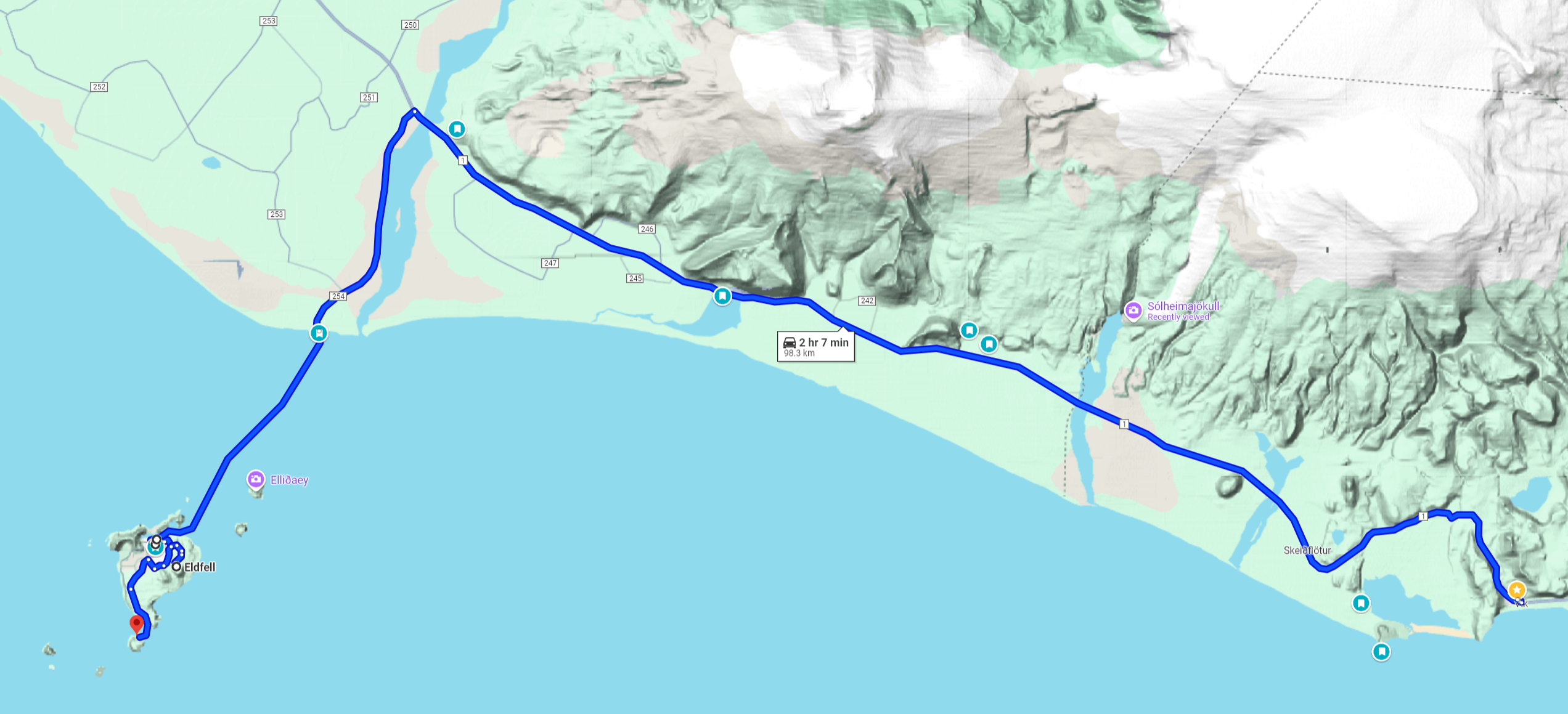
First Leg: Vík to Landeyjahöfn (74 km, 0:57 hr.)
The first bit is a drive out to the ferry landing at Landeyjahöfn, which is in the middle of nowhere, even for Iceland. It was only 74 km, but it seemed longer because of the rain and fog. Also, I always stress about things with fixed departure times. When we got there, there wasn’t much there there. It was a pretty nondescript place. This photo is not mine, it was rainy and foggy that day.

It’s just a parking lot next to a sheltered dock. Little else to be seen. The reason seems to be that this is a recent change for the ferry. It used to dock at the town of Þorlákshöfn, about 60km to the west. While that was closer to Reykjavik, the trip was 75 km and took 3 hours, in calm seas. This landing is much closer to the islands, only 12 km away, and takes just 30 minutes.

You can either park at the landing and take the ferry as a regular passenger or drive your car. You don’t really need a car on the island, as it’s only 5 square miles, most of which is a volcano. However, we were staying the night over there, and dragging luggage around was not really a plan, given that we couldn’t get into our hotel until 1600 and it was raining.
The ferry costs 2400 Kr (~$18.50) per person and 3750 Kr (~$29.00) for a car under 5m (most cars) and sails every two and a half hours. Oh, and they are quite proud that the ferry is electric, since electricity in Iceland is 100% geothermal and almost free.
It wasn’t entirely clear how everything worked, but I guessed where to line up. Fifteen minutes before sailing time, a guy came through the line with a barcode scanner to check tickets. Then we were waved aboard. It’s pretty cool, and I should have taken a picture of the inside. It’s basically a very tight two-level parking garage. It had two lanes to the left and two lanes to the right. When the bottom was full, the little ramp that had been down became a little ramp that was up, and loading continued.
Second Leg (via Ferry): Landeyjahöfn to Port of Vestmannaeyjar (15 km, 0:35 hr.)

You couldn’t stay in your car. Not that you would want to; it’s dark and crowded. The center section held stairs leading up to an enclosed lounge area with comfortable chairs, a snack bar, restrooms, monitors, and large windows. For the adventurous, there was the open weather deck, where you could enjoy the balmy (Icelandic) spring weather: about 40 degrees, breezy, and rainy. Add in we’re doing about 12 knots over open ocean with a water temperature not terribly above freezing. I am sure it’s lovely, but we stayed inside.
Once we left the little harbor, there wasn’t all that much to see. The rain and fog obscured the islands until we were approaching the harbor at Vestmannaeyjar. The lounge was moderately full, with approximately 40% of the guests being Icelandic commuters and 60% tourists. What are the available work opportunities in a town of about 4,500, other than internal support (grocery, building services, minor tourism, police, fire, etc.)? I’m unsure.
We spoke with some locals (see below), and they love it there. It is picturesque. However, you are living on a small volcanic island with a volcano that erupted in living memory (1972), mostly destroying the town. Yet, here they are. To be fair, half the residents who lived on the island when it last erupted didn’t return. They settled in the town of Grandavik, the one where the latest eruptions are taking place… Maybe we shouldn’t invite them to move here.
Fourth Leg: Port of Vestmannaeyjar to Puffin Lookout to Eldfell Viewpoint to Port of Vestmannaeyjar (~15 km, 2:15 hr.)
When the ferry docked, the lounge emptied quickly. The Icelanders were quickly in their cars and ready to roll off. We had to move quickly to get to our car and not be That Guy who holds up a whole aisle of cars by not being ready. Luckily, my sense of direction came through again, and I chose the right stairs and direction to find the car easily. In less than 10 minutes we were off the ferry and carried off into town by the flow of traffic.
We had about 30 minutes before we were to meet for a scooter tour of the island, and importantly, the puffin nesting areas. Puffins are the motivating force behind the choice of season and location for this trip to Iceland. The Westman Islands are home to the largest breeding grounds for the Atlantic puffin (Fratercula arctica). They are seabirds that come to land in late April to breed and raise young before heading back out to sea in August. Summer is crazy with tourists from late May to the end of August, when school is out and half of Europe is on holiday. So, we decided to arrive here before the crowds, but hopefully late enough that the birds would already be there.
The subReddit r/VisitingIceland is a tremendous resource for planning a trip to Iceland, and this trip was largely based on intel gathered there. Several of the frequent posters are natives who patiently answer the same damn questions over and over. But we noted with relief that they announced the return of the puffins a couple of weeks before we went, so we knew they were there.
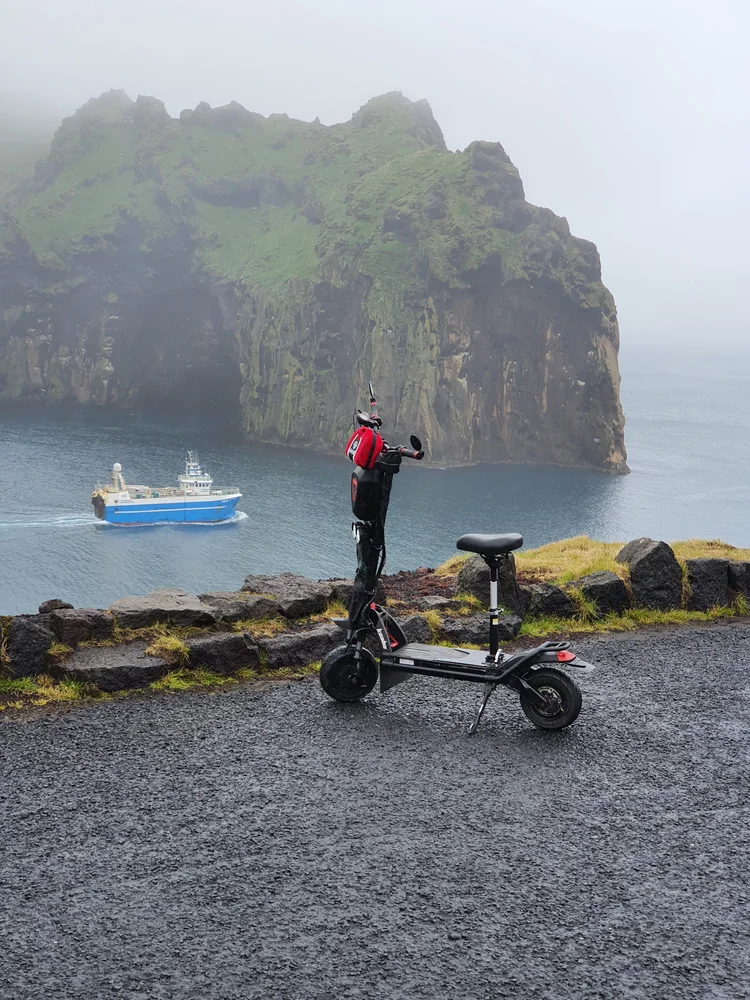
I had booked us for the 1.5-hour Eyjascooter Puffin Tour at noon. After a bit of driving around (it’s a very small town), we found a place to park and attended the meetup. The tour company is a husband-and-wife operation. Hreidar leads the tours, and Ingibjorg manages the storefront, ticketing, and outfitting customers. Please do not ask me to pronounce their names. They outfit you with a high-visibility vest, a helmet, and a small electric scooter that, in theory, was limited to 25kph, though that speed limit was violated nearly immediately and at times quite terrifyingly.
Once outfitted, they take you to a parking lot next to the building and have you drive around it for a bit to ensure you can manage without falling off. This was a very good thing, as it had been many years since either of us had been on a bike, and a little safe practice helped. We felt barely competent, but Hreidar pronounced us very proficient and led us off into the streets of Heimaey.
I’ll note that we were the only people who showed up for this tour. It was both early in the season and raining. Not a hard rain, just the usual drizzle, like London, only cold. Hreidar noted my camera poking out of the bottom of my raincoat and said it looked like an expensive camera. Is it OK if it gets wet? I assured him that it was an expensive enough camera that it could get wet without issue. Since we were here for birds and there was no way to carry anything spare on a scooter, I fit the Tamron 70-300mm zoom lens and hung it between my fleece layer and the jacket to protect it from unnecessary weather, but keep it handy when shots presented themselves.
We traveled uphill through the residential area of town while he gave us some background. In his 30s, he’s lived on the island all his life, so everyone knows him (population 4400) and sees him leading lemmings on scooters through the streets every day. He came to do the tour from his “day” job in construction. I inferred there was some agreement with his employer that he could randomly take an hour and a half off whenever he had a tour booked.
There are a couple of farms at the top of the hill, past the residential area, and then it’s downhill across a narrow land bridge to an extinct volcano, where the road winds up to the summit. Near the summit is a small parking area and a gated path leading to a building constructed as an observation platform, known as Fuglaskoðunarhús (Puffin Lookout).
From its balcony, you can see the nesting sites of thousands of seabirds. Some as close as 10m away. This is where all my puffin shots originate, and this is where all the best shots are taken; the ones that fill the calendars and photo books in the gift shops. At 300mm, I had a fair selection of nesting sites to choose from. Puffins dig burrows, which makes sense when you consider they’re on a steep hillside above the ocean in the North Atlantic. It’s breezy here.
Actually, at the top of the hill above the town, and again near the summit here, the rain started to sting — sleet. While cold, that’s actually better than rain in my opinion; sleet won’t leave droplets on the lens.
A serious bird photographer would have had a 500mm or 800mm lens and would have had an even greater selection of sites to choose from. If you want a candid shot of the bird doing something interesting, you have to set up your shot on a nest and wait for it. They take off quite suddenly and are very awkward-looking fliers. But fast, so if you’re not already on them, you won’t get a good shot.

Again, thanks to the weather, we were all alone up there and spent half an hour watching the wacky birds. Then Hreidar led us down the hill and back up the other side, around to the quiescent volcano, Eldfell. We didn’t go all the way to the top and take a look into the caldera, though we could have; there’s nothing much to see, as it’s been more than 50 years since the last eruption. But the whole upper half of the volcano is like a scene from Mordor, heaps of blackened rock, pumice, and ash. Amidst all that, there is an overlook on the back side with a view of the approach to the harbor, Flakkarinn Scenic Overlook.
From there, it was all downhill back to the harbor area and the shop following Hreidar. But, oh so downhill it was. With the scooter cranked, it will easily go 35 or 40 kph. That doesn’t sound like much; it’s maybe 25 or 30 mph. But you are on an open scooter, on a winding, wet road, with something like a 10-degree slope. And the scooter has these little 10″ tires for traction. Oh, and at the bottom of the hill (volcano) you’re suddenly back in town with (cross) traffic and everything. I have done more terrifying things, but the list isn’t really long.
After the tour, we spent some time chatting with Hreidar and Ingibjorg. We got some tips on places to eat that were good, but not too expensive. We somehow got on the subject of our SCA names, since our personas are, after all, Icelandic Vikings. We got the actual pronunciation of Eydis, which is apparently still in use. However, they had nothing for Galmr. It’s documented in the 11th Century, but somewhere in the intervening 1000 years, it fell out of use.
Fifth Leg: Port of Vestmannaeyjar to Westman Islands Inn (1 km, 0:05 hr.)

The Westman Islands Inn was an interesting experience. This is one of the new breed of low-touch hotels. After you make the booking, they send you an email with the code for the front door, the room number, the code for the door, and the time that it will activate (1600 in our case). We saw no one during our stay. Literally, no one.
After driving through the rain on a scooter for a few hours, we wanted a warm, dry place to recover and take a nap. Unfortunately, it was too early to get into our hotel room for the evening, so we roamed around looking for a place to eat lunch.
We ended up at Vöruhúsið (don’t ask me to pronounce this either). The menu had titles in “English”, but the ingredient lists were in Icelandic. That made me cautious since I was looking for something along the lines of warm comfort food. Jess had a small pizza, and I had their “Super Nachos”. Both were excellent, suitably warm, and typically expensive for a restaurant catering to the tourist trade (6,870 Kr or ~ $52).
Now we could get into our hotel room. Once we found it. I had the address, of course, but the entrance was subtle (see the photo). It’s just a door on the side of a building with a retail space on the ground floor. The upper floors are all rooms. We were able to park close by, luckily. Once we got the door open, we were greeted by a fairly steep and narrow staircase. The kind where you have to make 2 turns between each floor. That made dragging our suitcase up to the third floor a challenge.
The room code worked, and we were greeted with a no-frills room with a bath. Think of a college dorm room decorated by IKEA. The two single beds occupied about 70% of the floor space. So, while we’re not the type to expect a luxury suite or anything, it was barebones. And only $259/night.
We ate dinner at Gott, the other place Hreidar and Ingibjorg recommended. This was another place where I suspect few islanders eat, except maybe on special occasions. It was lovely, a high-end looking place with tastefully retro art. As with all of these restaurants, they aim for the high end because food is generally expensive in Iceland, so it’s only another 25% to go from a seemingly overpriced hamburger to something gourmet.
The place had a fully bilingual menu so we could be more adventurous. I got the Penne Pasta dish, and Jess got the Honeybaked Icelandic Cheese (see photos). Together with soft drinks, this came to around $65. Comparable to an upper mid-range restaurant back home.

At some point between napping and dinner, the rain ended, and the skies cleared, giving us bright blue skies in a soft twilight light. Even 12 km offshore, the low sun angle blocked the last 2-3 hours of daylight behind the central highlands. So, we decided to walk off some of the dinner and strolled down to the harbor. You can see from the time on my phone that it was 8:22 pm, but there was virtually no traffic and no one around on foot.
After the harbor, we ambled back to the hotel for the evening.