
In the next couple of posts, I will be trying to catch up on months of not posting about the goings on in the shop. We’ll start with some tool p0rn.
After bench planes, hand saws are the most iconic hand tools out there. Anyone that does woodworking has at least one even if they are pretty exclusively power tool users. Most have several. Fortunately for my tool business, there’s a high demand for vintage saws especially those from the famous makers like Atkins and Disston.
I have several myself including a full height Disston No. 7 from the late 1800s that’s in really nice shape. I think I paid $1 for it (5 for $5) at an auction 10-12 years ago. These days I could sell it for north of $300. But I won’t. I also probably won’t use it. Not because using a valuable tool is a sin or anything, but I am not a good enough sharpener to do anything helpful to a fine toothed crosscut saw. My eyesight just isn’t good enough and the people that can do a good job want too much to do it and trusting the saw to the USPS twice seems foolhardy to me.When I am done with woodworking, I’ll sell it along with all the other tools unless one of the other of my sons takes up the craft.
Why use a handsaw when you have so many power saws? Well, a couple of reasons:
Convenience – You pick it up and it’s “on”, no batteries, cords, etc. I keep a cheap one in a bin in the back of the truck in case I need to break down stock to get it home.

Safety – It’s easily the safest way to make wood smaller short of sanding. And I am not talking just in the qualities of the hand saw, but also what it keeps you from doing with a powered saw. I am pretty good with saws of all sorts, that is, I can usually follow the line. It’s harder than it sounds, especially if straight is one of the success criteria. A table saw or a chop saw have built in fences making straight automatic. So, it’s often the go to saw for straight cuts. But, the same thing that makes straight cuts also limits what you can do with them: the fence.
Generally speaking, you can only make cuts +- 45 degrees on these machines. And sometimes you can’t flip the item around and make that 70 degree cut a 20 degree cut. So you’re stuck figuring things out, like the photo above. Don’t do that. However, with a hand saw, if you can draw a line, you can cut that line.
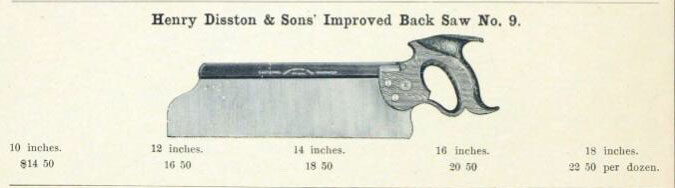
Anyway, saws. One of the affordable modern makers of saws is Bad Axe Tool Works. Recently they decided to produce a replica of the classic Disston No. 9 Precision Tenon Saw featuring the 1874 Reagan patented ergonomic handle. This handle was way ahead of it’s time and didn’t really catch on in the 19th Century. Finding one of the vintage ones is a tall order and consequently, an expensive proposition.
This half-back style was uncommon and definitely a later evolution of saw. But for someone that only does so much hand sawing, the versatility of this saw is hard to beat. The relieved back allows you to get into tight places, something you run into making furniture, hence my interest.
For whatever reason, the guys at Bad Axe decided there was a market for a limited run of replicas and they were right. Collectors wouldn’t be interested, but those of us that actually use hand tools would be. And as soon as I got the email announcing this saw, I ordered one. They were only going to make one run, so you had to get your order in before the end of the month.
As you might imagine, a semi-custom run of a fancy saw isn’t cheap. The “base” price was $350 for one with a white oak handle, blackened steel back and the standard 12 ppi hybrid cut filing. The only change I opted for was a cherry handle so it would match my other saws, +$20. They delivered in within two weeks, completely astonishing for a small company like that. And the saw cuts really nice in my couple of test cuts. We’ll see about the rest when I get to a cabinet type project.
