[Originally posted on Facebook (11 Nov 2024)]
What follows is a tale of how I used my auction expertise to help a friend buy a horse at auction. You’ll see how auctions work and how a little psychology and game theory can help you win more than you might otherwise.
Jess and I recently went to dinner with Denis and Barbara one Friday night. They are a retired couple in our neighborhood whose property backs up to the woods around the Supplee Reservoir. They have enough land to have horses and have three Icelandic horses (it’s a separate breed and a whole story on its own). Jess has been hanging out with Barbara for the last couple of years, going on adventures, helping around the place, and riding the horses on the trails around the Reservoir.
At dinner, Jess and Barbara were making plans for the next day. They wanted to go to this horse and livestock auction in Thurmont and check out an Icelandic that was in the sale. Two of Barbara’s Icelandics are 30+ years old and can’t be ridden much anymore, so she was looking for another so she would have at least two usable horses for trail riding. The debate was over how serious she was about going for the horse, whether to take the practical Honda on the road trip or take the truck/trailer, hoping the horse was as good in person as it looked in the listing (and that they won it).
Knowing that I always go to auctions, they asked if I would do the auction part for them. I was happy to do that. I love live auctions. But I didn’t want to spend all day on a Saturday in Thurmont. As lovely a place as it is, as the only one at the table with a day job, I like to get some shop time in, and the horses weren’t going up until 4 p.m.
So, I proposed they go to the auction in the Honda early and check out the horse. If they decide they want it, they can call me. I would get Barbara’s horse trailer and drive up in time for the auction.
And so it was. At 2 p.m., Jess called, excited about the horse, and told me to fetch the trailer and get up there. With Marcus’s help, I got the trailer and went to the auction just as they started the horses. Our target was number 15, so I had 30 or 40 minutes to settle in and learn this auction’s rhythm. Plus, they had already saved me nice seats and the bidder number, so I was set.
As is typical for auctions, many may have numbers, but only a handful bid. My usual competition is other dealers, but at tool auctions, there are several hundred lots for sale; this sale had 20 horses. Most bidders were regular folks, nervous about bidding in big dollar increments and intimidated by the fast and loud auctioneer.
You get the hang of it once you have been to a couple and paid attention. They are trying to create a sense of urgency and interrupt higher brain function. You are unsure what’s going on and want that thing. Keep bidding. In practice, you have plenty of time. They work on commission, so they milk the last bid, trying for more.
You must be a little dispassionate at auctions; you will lose some. At tool auctions, I come armed with a list of lots I plan to bid on and the most I want to pay for. Since I am flipping the tools, I won’t spend more than half what I can sell them for. With that number fixed in mind, I can bid however I want until I hit the number. Then I stop.
If I win it, great. If not, I look ahead to the next lot I have targeted. I win about 1/3 of the lots I target. Knowing I would likely get called in, I researched what Icelandic horses in that age range (18-20 yr old) typically went for and figured we were looking at $8K to $10K to win this one. Some outliers exceeded $16K; I couldn’t see why. They looked the same to me.
Barbara set our budget at $12K, though there was some wiggle room if necessary. I was pretty sure we wouldn’t need it.
Auctioneers always start with an optimistic bid, hoping for a rookie or overeager bidder (like Jess and Barbara). In this case, they opened at $10K. Do nothing. They will cut it down until they get bidders. And, down they went: $8K, $5K, $4K, until they hit the left bid for $4K. Do nothing yet. You have plenty of time.
Once people start bidding, we’ve found the floor, and the fun begins. In this price range, the bidding increment is $500. So, with a $4000 left bid, they were looking for $4500. I waited, and sure enough, someone in the crowd bid $4500—perfect.
Anchoring on round numbers is a thing, and people hesitate to cross them. So now I jump in and bid $5K, a nice round number. If there is just this one bidder, I will always be on the round number, adding that little extra psychological strain to the other bidder. And, in fact, there was just this other bidder.
Now we turn up the heat and make them let me have the horse 🙂
I’ve found that people bid slower as they get closer to their budget. I don’t. When it’s my turn to bid, I immediately bid without hesitation until I hit my limit. Then it’s back on them to cross a round number and think about the money they’re about to spend.
Also, auctioneers love it when you bid fast; it adds to that sense of urgency they are trying to build. So it went back and forth for a while, but, as I predicted, they started to slow down, and in the $8K range, they bid $8250 instead of $8500. That’s called cut bidding; most auctioneers will let you do it. Auctioneers will sometimes do it if they sense they might be able to pull one more bid out of you.
Now, I sat back with a smile and told Barbara we had this. Once your opponent makes a cut bid, you know they are close to the end of their tether. We were nowhere near ours. It’s very unusual for bidding to go much further once cut bidding starts.
And it didn’t. They bowed out, and we got the horse under my $10K personal target. It was huge fun and well worth the trip. And, of course, we have another horse, which led them to get me out there riding with them. That’s another story, too.
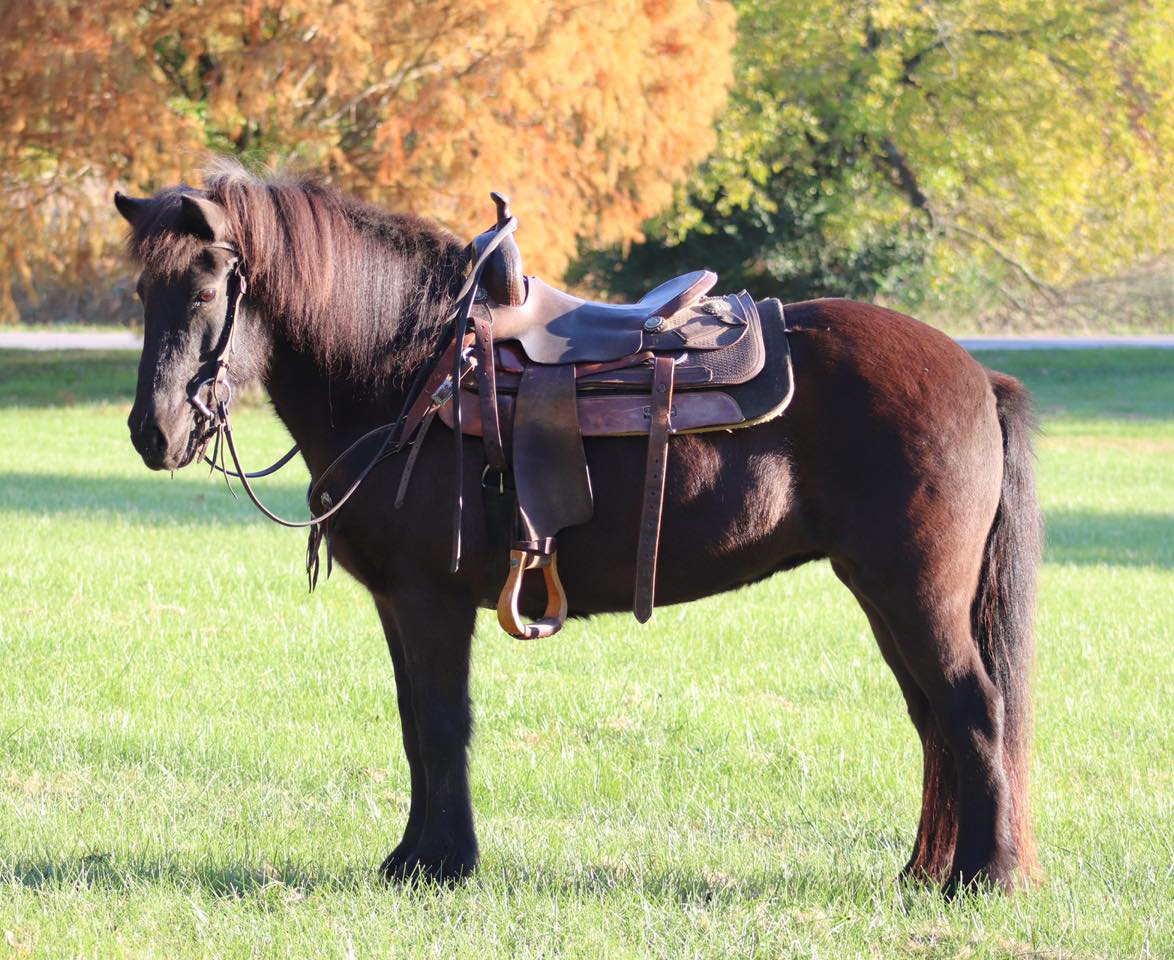
Meet Hekla, a 19 yr old Icelandic mare.